
From South Kalimantan to the Siachen Valley, Indigenous Youth Are Rewriting the Climate Agenda

By Alvian Wardhana, CSO Lead, Literasi Anak Banua and Shamim Akhtar, Indigenous Youth Climate Advocate

In April 2026, young people from across Asia and the Pacific led climate discussions at UNFCCC Climate Week 3 in Yeosu, Republic of Korea. Among them were two Indigenous youth advocates from the forests of South Kalimantan, Indonesia, and from the mountains of Pakistan who arrived with different stories but left with the same mission that Indigenous and frontline communities must be climate solution makers. Here, they reflect in their own words.
South Kalimantan, Indonesia
Alvian Wardhana, CSO Lead, Literasi Anak Banua

With support from YECAP, I participated as a knowledge holder at the LCIPP Biregional Gathering during Climate Week 3, a space that brought together Indigenous Peoples, local communities, and UNFCCC representatives to co-create ways to embed diverse knowledge systems into climate action.
I shared how the Dayak Meratus communities in South Kalimantan have been adapting to climate change, and presented Meraki, my Indigenous youth climate incubator programme. Listening to other knowledge holders, from co-managed national parks to AI-assisted biodiversity protection, reinforced a perspective I will carry forward. Indigenous Peoples can accelerate the climate agenda when included across all levels of the process, not only at the margins.
During the meeting, I delivered an intervention on the Baku Workplan 2025-2027, calling for Indigenous knowledge to be recognized as intellectual property, for Indigenous voices in National Biodiversity Plans, and for improved climate finance access for Indigenous Peoples' Organizations. I also co-facilitated an ACE session on the Just Transition Working Group, where I saw firsthand how formal recognition of youth and children in NDCs, reflected in 64 mentions in the third edition, can shift the terms of engagement.

My preparation through the YECAP-supported Climate Policy Innovators Youth Camp 2.0 in March 2026 was crucial. Negotiation simulations gave me the technical grounding to engage confidently, bridging youth-led advocacy with the procedural realities of climate diplomacy. I return to Indonesia with networks, tools, and a clearer mandate to channel these learnings into national biodiversity consultations and to accelerate climate finance pathways for the Dayak Meratus people I serve.
Siachen Valley, Pakistan
Shamim Akhtar, Indigenous Youth Climate Advocate

When I boarded my flight home from Climate Week 3, my notepad was full and my mind was racing. One question stayed with me: Are we building tables where young people and frontline communities hold real power, or are we simply adding more chairs to the same old rooms?
The LCIPP gathering gave me cautious hope. In a plenary sharing circle, Indigenous knowledge holders spoke without PowerPoint slides. One elder described how a river his village had depended on for generations had changed course in under a decade. That session taught me that climate understanding is not only numbers, but also memory, relationship, and accountability.
What tested my patience was the financial session on the Belém Gender Action Plan. Fund after fund presented toolkits and scorecards until a woman farmer from a Pacific island country said what everyone was thinking, "Your requirements are built for institutions, not for us." The most honest moment came from Agra Industries, "What changed was not just access to finance. It was access to the ecosystem." That reframed everything for me. Finance alone does not transform. The mentorship, networks, policy space, and recognition surrounding it do.
I return to Pakistan with three commitments to document Indigenous food system knowledge in the Siachen Valley as climate data; to advocate for a youth climate empowerment working group using the ACE framework; and to push the GCF, ADB, and GGGI to treat grassroots women and youth as partners to be resourced, not beneficiaries to be assessed.
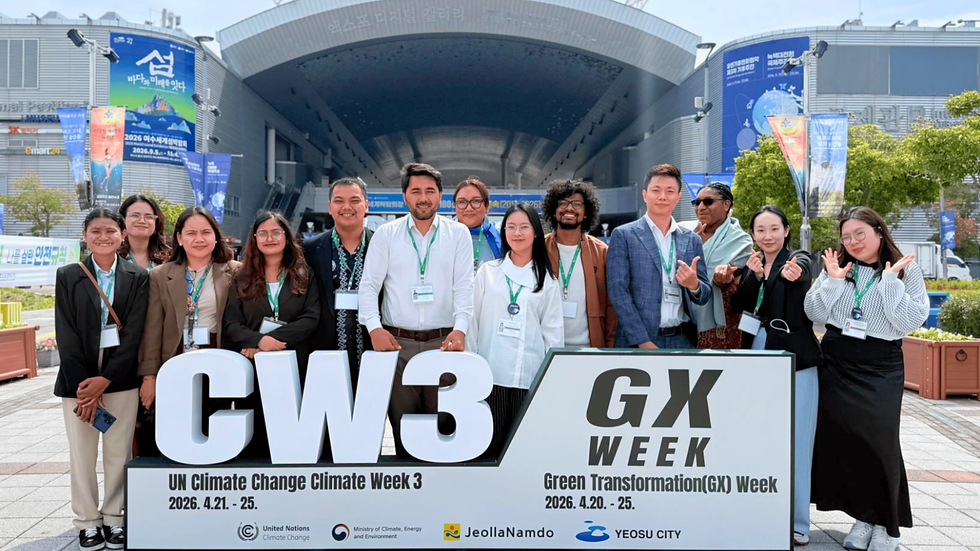
Two countries. Two communities. One shared call. Climate Week 3 reminded us that the solutions exist as they always have. What remains is the harder work to ensure those who hold them are trusted, resourced, and given the power to lead. YECAP remains committed to creating those safe and inclusive spaces for youth across Asia and the Pacific.
Both delegates attended UNFCCC Climate Week 3 with support from YECAP, UNICEF East Asia and the Pacific, and UNFCCC RCC Asia-Pacific.


Comments